Real estate has always been a data-heavy industry. Between lease agreements, property financials, tenant records, market reports, and compliance documentation, the volume of information that investment and management teams must process daily is staggering. The problem is that most of this work is still done manually, and that's exactly where AI agents for real estate are beginning to reshape operations from the ground up.
According to Morgan Stanley Research, AI can automate 37% of tasks across real estate investment trusts and commercial real estate firms, representing up to $34 billion in operating efficiencies by 2030.
Whether you're managing a portfolio of commercial properties, running due diligence on a new acquisition, or overseeing thousands of residential units, AI agents are proving to be one of the most practical and high-ROI technologies available to real estate teams today.
What Are AI Agents, and Why Do They Matter for Real Estate?
AI agents are software systems that can reason, plan, and execute multi-step tasks autonomously, often by connecting to internal databases, documents, and external tools. Unlike a simple chatbot that answers questions, an AI agent can ingest a lease document, extract structured data from it, cross-reference that data with a financial model, flag inconsistencies, and write a summary report, all without human intervention at each step.
For real estate teams, this matters because the bottlenecks aren't usually strategic. They're operational. Analysts spend hours reviewing documents that follow predictable patterns. Property managers respond to the same types of maintenance requests repeatedly. Investment professionals manually populate memo templates with data they've already gathered. AI agents eliminate these bottlenecks.
The Most Impactful AI Agent Use Cases in Real Estate Today
Investment Memo Generation
One of the most widely adopted AI agent applications in real estate investment is automated investment memo drafting. Investment teams regularly need to synthesize financial data, market research, deal terms, and risk factors into a structured memo, a process that can take days when done manually.
AI agents can be configured to pull relevant inputs (company financials, market comps, deal terms), conduct research, and generate a first-draft memo that follows a firm's specific template. Teams using this workflow report dramatically faster turnaround times and more consistent output quality across analysts.
This use case is so prevalent that investment memo agents represent one of the most commonly built applications on enterprise AI platforms, spanning private equity, real estate private credit, and direct investment teams.
Lease Abstraction
Lease documents are notoriously complex. Each one contains dozens of critical data points, rent schedules, escalation clauses, renewal options, termination conditions, tenant obligations, and compliance requirements, spread across unstructured text in varying formats.
Manually abstracting this data is tedious, inconsistent, and error-prone. A lease abstraction agent ingests lease documents in bulk, automatically extracts key structured data elements, and normalizes them into a consistent schema regardless of original format. One national property management company deployed this type of agent and saw lease review time drop by 70%.
The downstream benefits extend well beyond time savings. Standardized, accurate lease data improves reporting cycles, reduces compliance risk, and enables portfolio-level analysis that simply isn't practical when data lives in PDFs across shared drives.
Property Due Diligence
Acquiring a commercial or residential property involves reviewing a significant volume of documents, inspection reports, title records, environmental assessments, zoning documents, prior lease agreements, and financial statements. AI agents can be designed to ingest these materials, identify red flags, extract key data points, and surface them in a structured due diligence summary.
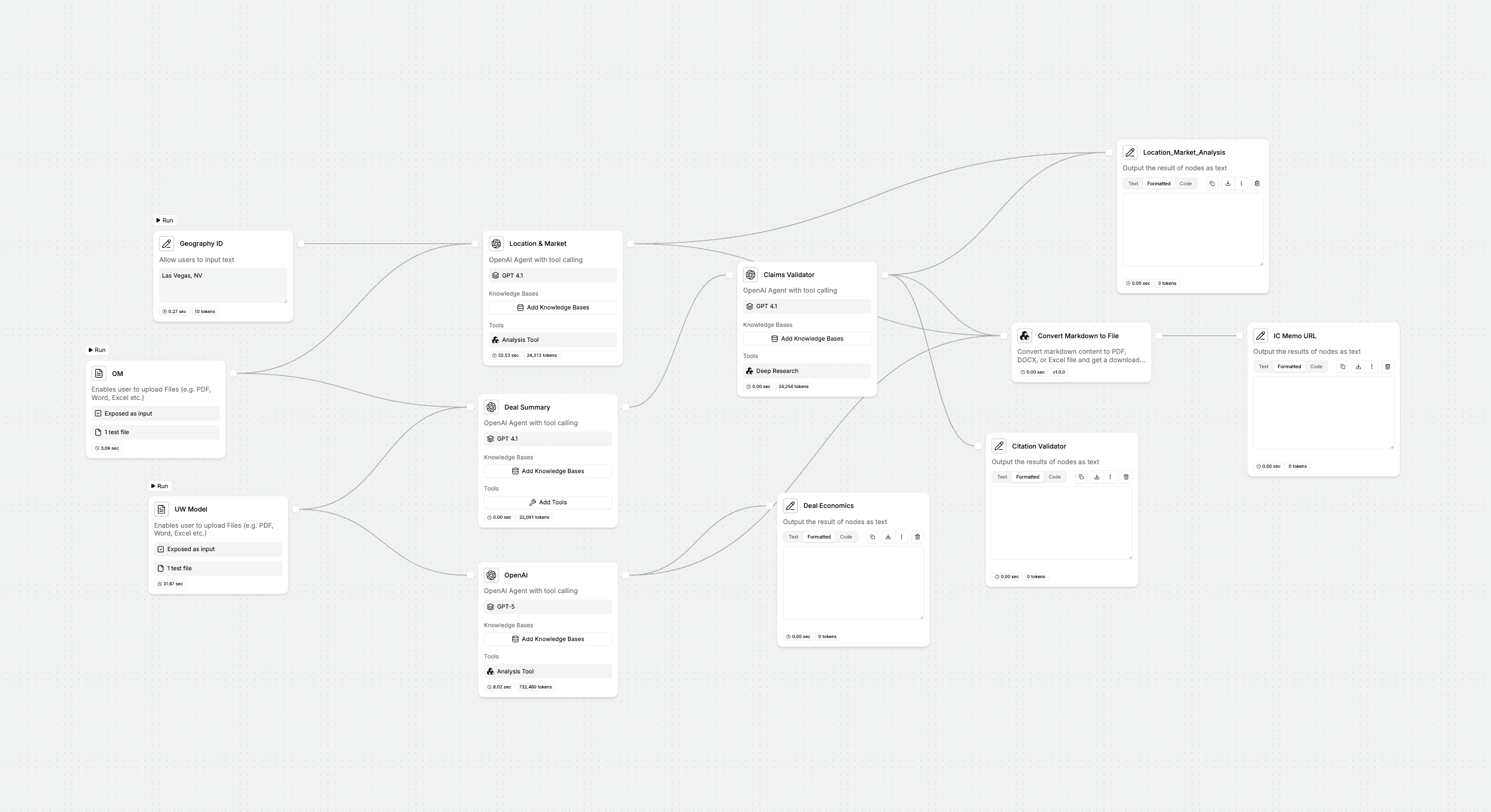
This is especially valuable for investment teams evaluating multiple deals simultaneously. Rather than having analysts work through each document sequentially, a due diligence agent can process the entire document set in parallel and flag items that warrant closer attention, accelerating deal timelines without sacrificing thoroughness.
Tenant Evaluation and Financial Analysis
Evaluating prospective tenants, whether for a commercial space or a residential unit, involves reviewing financial statements, credit history, business plans, OMs, and references. AI agents can automate the initial screening layer: ingesting submitted documents, extracting relevant financial metrics, scoring applicants against predefined criteria, and generating a structured evaluation summary for human review.
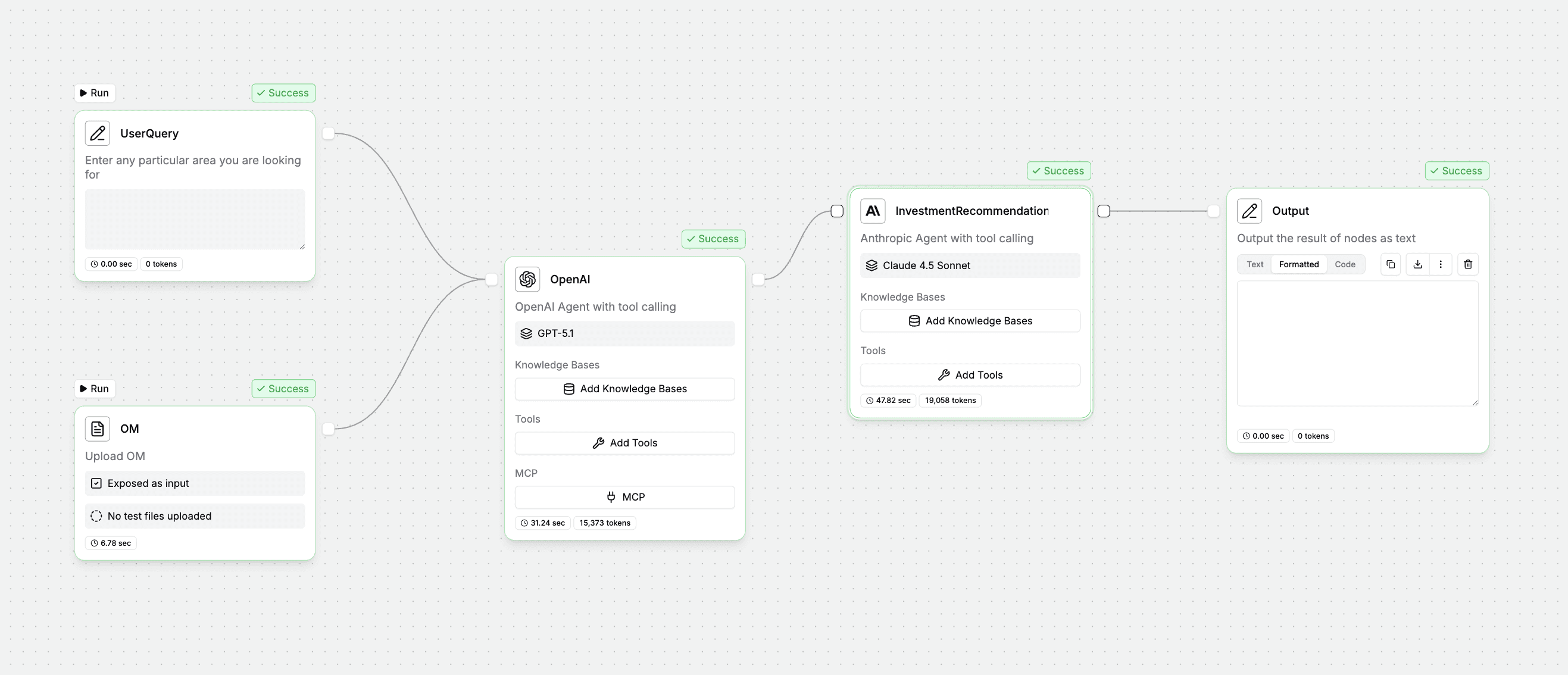
For commercial properties, this extends to ongoing tenant financial monitoring, flagging tenants whose financials show deterioration that might indicate future default or lease renegotiation risk.
Market Intelligence and Research
Investment teams need to stay current on market dynamics, cap rates, vacancy trends, comparable transactions, macroeconomic signals, and submarket performance. Manually aggregating this information from multiple sources is time-consuming and often results in stale analysis.
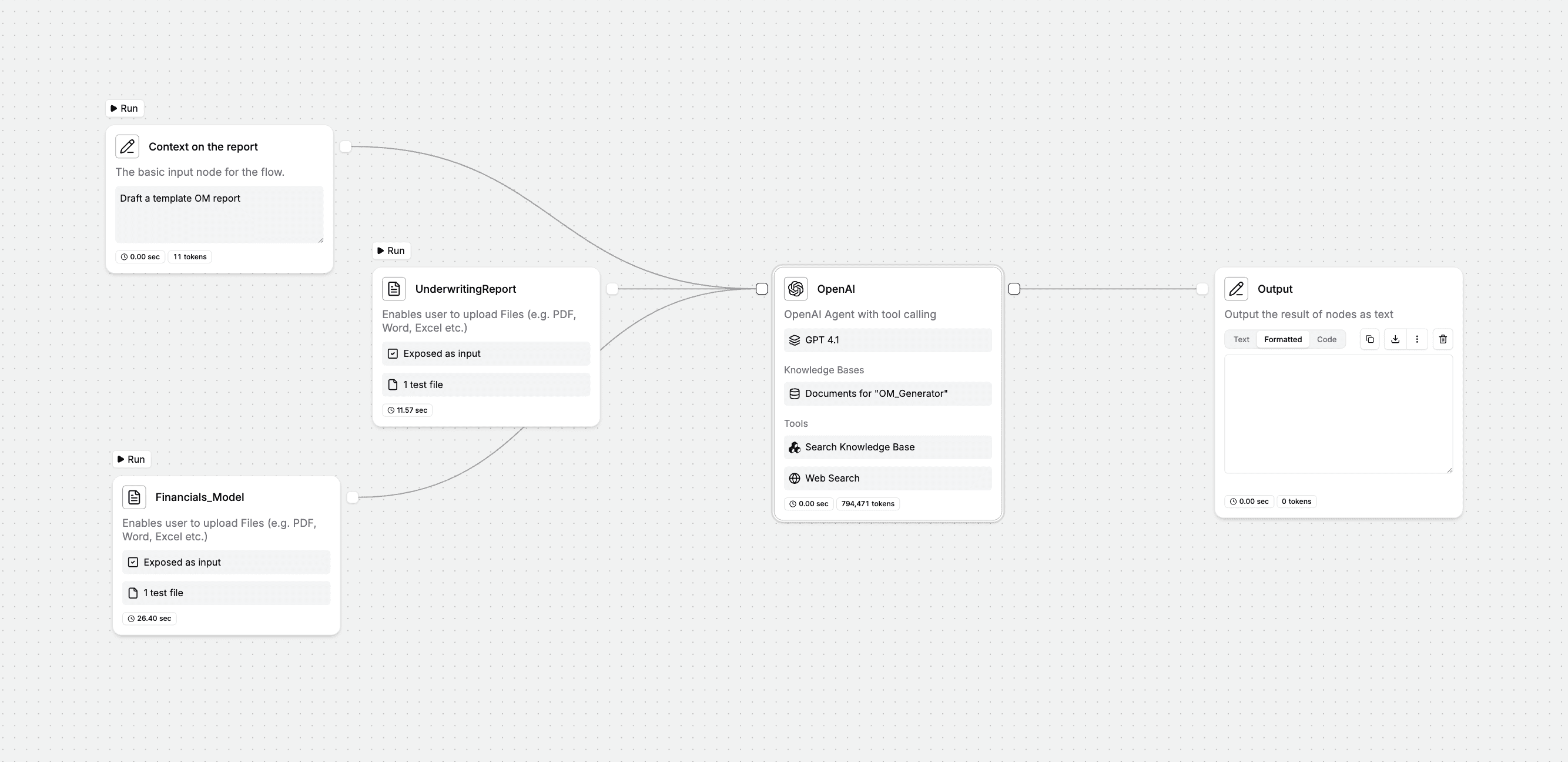
AI research agents can be configured to monitor relevant data sources, synthesize findings, and deliver structured market intelligence reports on a regular cadence. This keeps investment committees better informed and reduces the research burden on analysts, freeing them to focus on interpretation and decision-making rather than information gathering.
Property Onboarding and Data Extraction
When a new property is added to a portfolio, there's a significant amount of administrative work involved, extracting data from existing documentation, populating property management systems, setting up reporting structures, and ensuring all relevant information is accurately recorded.
AI agents can automate much of this onboarding process: ingesting documents, extracting key property details, and populating the relevant fields in systems like AppFolio or similar platforms. This reduces onboarding time and the risk of data entry errors that can cause downstream reporting problems.
Real Estate Loan Application Processing
For lenders and real estate finance teams, processing loan applications involves reviewing property appraisals, borrower financials, title documents, and underwriting criteria. AI agents can accelerate this review process by extracting and structuring relevant information, flagging missing items, and generating underwriting summaries, shortening decision timelines and improving consistency.
What Makes These Use Cases Work in Practice
The real estate AI agent use cases that deliver the most value share a few characteristics:
They involve high-volume, document-heavy workflows with predictable structure
The outputs feed into downstream decisions that benefit from speed and accuracy
Human oversight remains in the loop for final approvals on consequential actions
The agent connects to existing systems (property management platforms, databases, document storage) rather than requiring data to be re-entered
This last point matters more than it might seem. Real estate operations are deeply dependent on systems like AppFolio, Salesforce, and various data warehouses. AI agents that can read from and write to these systems, rather than operating in isolation, are the ones that actually change how teams work.
Security and data governance are also non-negotiable in this context. Real estate investment firms handle sensitive financial information, tenant data, and proprietary deal flow. Any AI platform deployed in this environment needs to meet enterprise security standards: no training on client data, strict access controls, audit logging, and compliance with relevant data regulations.
The Operational Edge in Competitive Markets
The property management and investment teams seeing the most value from AI agents aren't using them to replace judgment, they're using them to eliminate the administrative overhead that slows judgment down. When analysts aren't spending hours on lease abstraction, they're spending that time on portfolio strategy. When property managers aren't manually triaging work orders, they're focused on tenant relationships.
In competitive real estate markets, this operational efficiency translates directly into performance. Faster due diligence means more deals evaluated in the same time window. Better arrears visibility means fewer surprises. More consistent lease data means cleaner reporting and stronger compliance posture.
The firms building these capabilities now are establishing an operational advantage that will be difficult to replicate through headcount alone.
Getting Started
The most practical path to deploying AI agents in a real estate context is to identify the one or two workflows where document volume and manual processing time are highest, lease abstraction and investment memo generation are common starting points, and build from there. Each successful deployment creates a template for the next one.
Platforms like StackAI are designed specifically for this kind of enterprise deployment: connecting to existing systems, maintaining enterprise security standards, and enabling teams to build and iterate on AI agents without requiring engineering resources for every workflow change.
If you're evaluating how AI agents could improve your real estate investment or property management operations, book a demo with StackAI to see how these workflows are being built and deployed in practice. Learn more about StackAI for REITs here.
Want to learn more? Download the white paper: AI Agents: 10+ Use Cases Transforming Real Estate

Hakan Gureren
Enterprise AI at StackAI





